Build The Architecture One Chapter At A Time
-
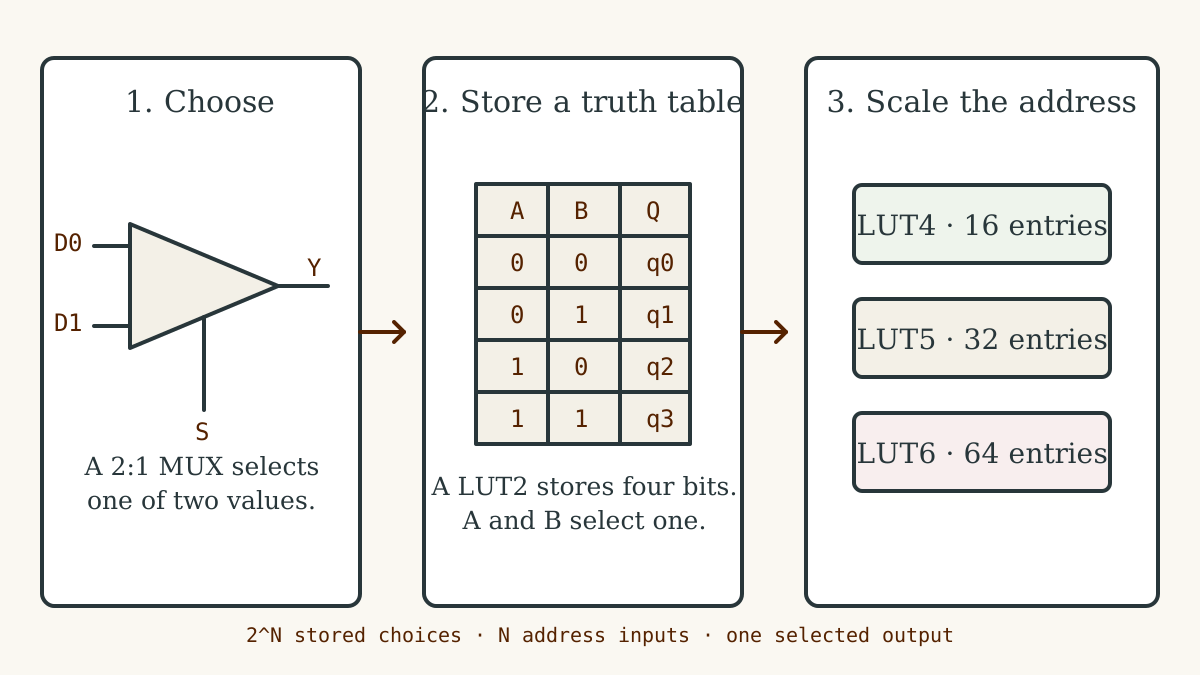
Logisim, The MUX, And LUT1 Through LUT6
Expose the selector, grow it into stored truth tables, then connect LUT4 to Lattice iCE40 and LUT5/LUT6 to AMD/Xilinx configurable logic.
2020 foundation: MUX Algebra writes local choice as a conditional, enumerates all 16 two-input Boolean functions, and defines the original four-bit configuration scheme.
Hands-on companion: the physical MUX tiles embody inputs, constants, selectors, routes, intersections, and orientation as fabricated PCB parts for a proposed STEM/EE learning path. The tile alphabet supplies a tactile route into the wider Cartilage architecture.
-
CMOS Inverters As Gain, Restoration, And Output Drive
Move beneath Boolean symbols. A real inverter contributes a voltage-transfer curve, transition-region gain, noise margins, finite output current, and capacitive load. Restoring stages and sized drivers carry reliable logic across fanout.
-
Clock, Event, And Reset Trees; H-Trees And Driver Grids
Treat every high-fanout event as a physical distribution system. Buffer trees, H-shaped geometry, grids, and segmented regional networks trade skew, insertion delay, energy, metal, and locality across clocks, resets, configuration edges, and application events.
-
Harel Statecharts And One-Hot Spatial State Machines
Use Harel statecharts to express hierarchy, concurrency, and event-driven transitions. Give every one-hot state a visible storage location, then connect behavioral composition to a machine whose active state occupies space.
-
Clock Regions And Timing Closure
Close the machine in physical space: placement sets path length, buffers carry fanout, congestion redirects routes, clocks cross regional resources, and final delays satisfy setup and hold constraints.
-
Metal Wires Are Part Of The Machine
Replace free arrows with layers, vias, resistance, capacitance, direction, and finite routing capacity. Cartilage side-metals expose locality; physical implementation maps that locality onto real routing resources.
-
OOP-Style Nested Components And Composition
Give each component state, identity, and an interface while its parent composes children and preserves their identities. Cartilage turns that software intuition into a bounded child region, a local interface, and a configuration path inside the fabric.
-
Runtime Instantiation In An Adjacent Region
Watch a parent stream a complete image through a local reconfiguration port into a neighboring daughter region. New wire, intersection, constant, MUX, and port roles turn bounded replacement into dynamic reactivity on space.
Anchor Every Layer In Primary Sources
Each source connects one chapter to a maintained tool, official device manual, primary paper, or physical-design reference.
Logisim-evolution
Use the maintained cross-platform logic design and simulation tool alongside the public multiplier’s legacy Logisim 2.7.1 circuit.
Lattice iCE40 Technology Library
Read the official SB_LUT4 primitive and its exact 16-bit LUT_INIT address mapping.
AMD UltraScale CLB Guide
Connect the official 6-input LUT and dual-LUT5 modes to their storage, carry, routing, and slice context.
MIT: Inverter Basics
Follow CMOS transfer characteristics, noise margins, and sizing into the restoring gain stage beneath digital logic.
AMD UltraScale Clock Structure
Trace clock regions, horizontal spines, vertical and horizontal tracks, roots, leaf buffers, and segmented regional distribution.
Harel's Statecharts Paper
Read the 1987 primary paper that introduced hierarchy, orthogonality, and event-driven behavior as one visual formalism.
AMD Timing-Closure Methodology
Use constraints, clocking, congestion, path delay, and skew to drive a placed and routed design into timing closure.
OpenROAD Parasitics Estimation
Estimate routing-layer resistance and capacitance with distinct clock and signal wire models after placement or global routing.
Put The Foundations Into The Running Fabric
Open One-Slot Multiplier
Change two four-bit operands and watch the self-contained routed multiplier propagate through the visible WebGL fabric without an account or backend.
Public Artifact And Private Circuit Authoring
See how the open multiplier leads into private editing, loading, saving, sharing, and browser, Raspberry Pi, and FPGA streaming work.
Cartilage Visual Language
Decode reconfiguration ports, crosses, constants, wire orientations, and MUX modes across a complete fabric render.
Nested Instantiation
Watch local ports install bounded daughter regions through serial replacement.
Cartilage Core
Open the compact WebGL1 model, hardware paper, SystemVerilog RTL, Verilator testbench, and exact 252-bit installation.
Cartilage Development Roadmap
Build renderer ergonomics, deterministic region roots, ownership overlap, recovery, simulator controls, saved circuits, and interactive lessons.
Cartilage Compute Hardware Paper
Read the editable architecture paper for the local configuration protocol, cell roles, ownership boundary, runtime application behavior, and verification architecture.
Open the wider Cartilage run index for complete run packages, timelines, placement maps, and circuit traces.
Preserve The Running Lineage And Extend It Deliberately
The self-contained WebGL machines retain their original execution paths, while these articles supply modern context, mechanism, and navigation around them. The broader run index carries additional timelines, placement maps, and circuit traces beside this teaching sequence.
Every new chapter adds a clear construction, an attributable diagram or running machine, primary sources, and one deliberate next step. That discipline turns Cartilage into a coherent architecture for learning, use, and collaborative development.