Control The Arrival Time At Every Destination
A source drives wire capacitance, buffer inputs, register clock pins, reset pins, and other loads. Network resistance and capacitance add delay; branch geometry and routing detours create mismatch; process, voltage, and temperature move every result.
Skew measures the arrival difference between two destinations. Setup and hold analysis includes clock skew, event networks define whether destinations may observe different cycles, and reset networks control when state activates after release.
What Hides Under The Clock? reconstructs Brian’s attempt to move beyond synchronous design, the mechanisms that failed, and the way clock boundaries became communication boundaries across his engineering work.
Bound Fanout With A Buffer Tree
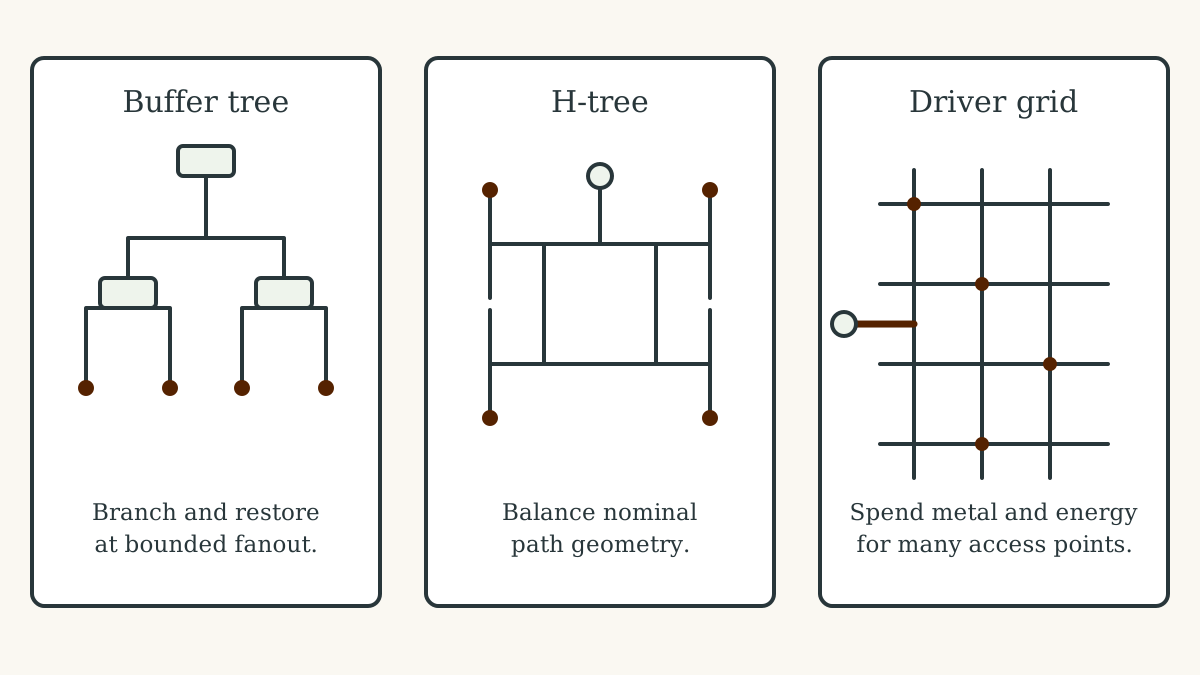
A tree divides one large load into smaller branches. Each buffer drives a bounded set of child buffers or leaves, while stage count, branching factor, placement, and wire length set the delay and load at every level.
A logically balanced tree gives each leaf the same stage count. A physically balanced tree also equalizes route and load, turning schematic symmetry into controlled arrival after placement and routing.
Balance Nominal Geometry With An H-Tree
An H-tree recursively divides a rectangular region. A source enters near the center, equal-length branches reach the centers of subregions, and the pattern repeats until selected leaves share the same nominal path length.
Loads, obstacles, wire layers, local variation, and final routing refine that geometric starting point. The H-tree makes spatial balance visible and gives physical design a symmetric network to characterize.
Trade Capacitance For Dense Access With A Grid
A driven grid offers many nearby tap points and multiple paths, reducing sensitivity to any single route and simplifying local access. It spends switched capacitance, metal, driver current, and design effort to gain that reach.
Trees use less wire and depend more strongly on branch balance. Grids allocate more physical resources across the surface. Hybrid networks combine a tree or spine for long reach with local meshes or grids near the loads.
Use Dedicated Regional Clocking In Modern FPGAs
AMD UltraScale devices divide the fabric into clock regions with horizontal clock spines, vertical and horizontal routing and distribution tracks, clock roots, and leaf buffers. The official Clock Structure chapter of UG572 shows segmented resources forming device-wide and local clock networks.
The device-specific fabric turns the general topologies above into explicit regional boundaries and routing resources. Implementation tools select, place, and connect that network for the actual load pattern.
Give Clock, Event, And Reset Their Own Semantics
A periodic clock participates directly in sequential timing. An event may arrive as a pulse, transition, token, or locally acknowledged action. Reset establishes or restores a known state through its own assertion and release protocol.
High-fanout drivers, trees, regional spines, and local leaves can serve all three networks, while each signal retains distinct correctness conditions. Altera’s current state-machine reset guidance identifies a concrete failure mode: partial reset release can place a one-hot machine into an illegal state.
Keep Cartilage Control Paths Spatial And Explicit
Cartilage moves configuration edges, local ownership, region replacement, events, and state alongside application data. Explicit spatial paths let the architecture expose control transport instead of hiding it in a global plane.
The WebGL and RTL run local configuration mechanisms across bounded regions. Physical clock, event, and reset closure supplies the next engineering layer; the next chapter first defines what each event activates and how hierarchical behavior occupies visible state.