Carry Object Composition Into Spatial Hardware
An object holds state, exposes an interface, contains other objects, and preserves identity while its internal state changes. Cartilage carries that compositional intuition into a physical region with explicit ownership.
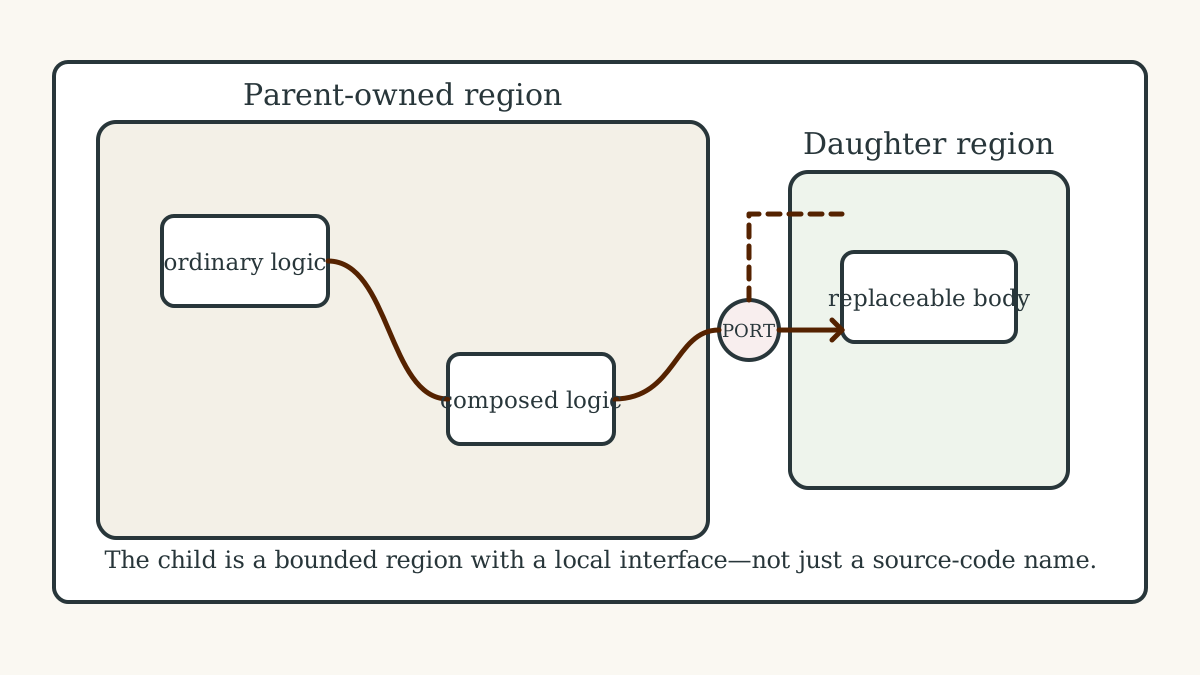
A parent owns a specific child, communication crosses the child’s interface, and replacement changes that child while the larger composition retains its structure.
Reactive Model Composition develops the larger model through composing agents, private state, streamed deployment, unallocated space, and direct channels between constituents.
Separate Circuit Composition From Region Composition
A compiler can expand a function, macro, class, module, or repeated helper into ordinary logic inside the current region. An independently reconfigurable child adds owned space, a boundary, and a configuration surface.
Current QuadFlow semantics express both composition modes directly:
A concrete configuration allocates the child region and declares its owned space.
Execute The Interface At The Spatial Boundary
Cells, side connections, ports, and routes form the boundary. Together they determine where application values cross, where configuration enters, and which cell owns each parent-to-child transition.
The fabric state and propagation path expose every missing route, wrong orientation, misplaced port, and broken ownership pointer directly at the interface.
Replace A Child Through Its Local Configuration Surface
Application ports carry the child’s computation. A separate local configuration surface receives the image that defines what the bounded region becomes.
In Cartilage, a local reconfiguration port connects the parent-facing stream to the daughter’s ownership tree. One complete image replaces wires, intersections, constants, MUXes, and port roles inside that region. The image-dependent port remains part of the spatial fabric.
Give Identity And Lifetime A Spatial Form
A child can retain its boundary location and parent relationship while a replacement image changes its interior roles and application behavior. An installation path that supports port relocation can also move which cell serves as the interface.
The current compact Core runs one manually specified 6x6 installation through one port arrangement. The broader preserved substrate runs nested spatial behavior. A second installation through a relocated port and a general high-level allocator and placer form the next composition layer.
Make “New Variable” Allocate A Neighboring Machine
Dynamic variable instantiation becomes spatial: a running parent requests a child, an adjacent bounded region supplies its storage and logic, and a local stream defines the new machine.
A future high-level new operation can target that architecture through allocation and placement. The next page runs the canonical local-port and bounded-region mechanism in the browser.