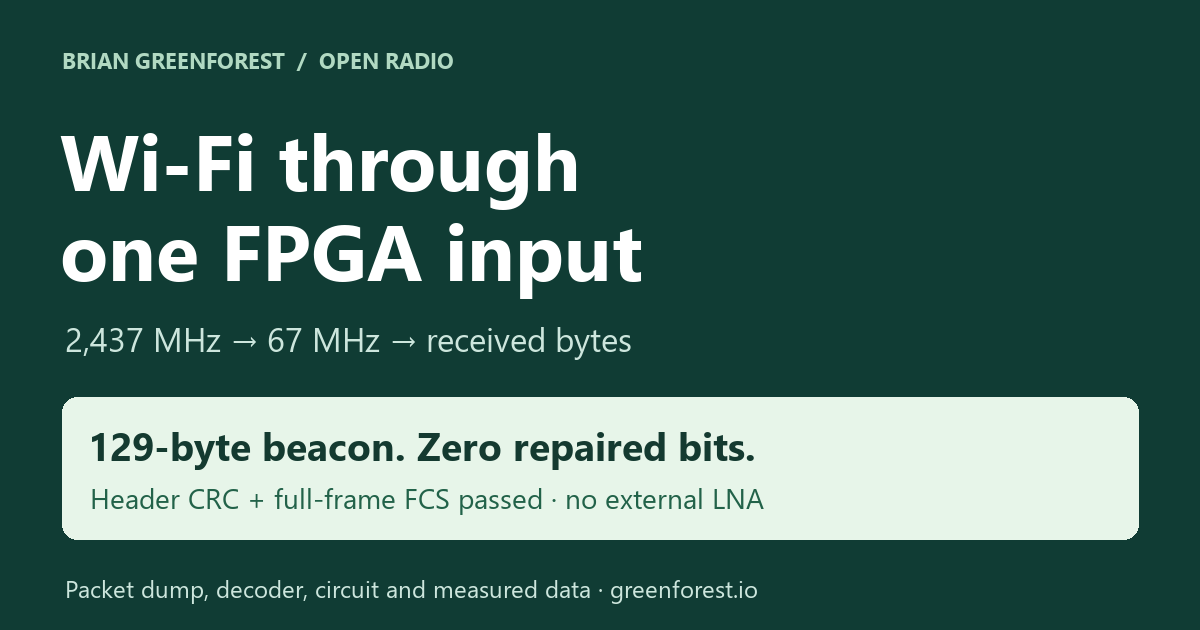
Wideband front end meets Wi-Fi
2.437 GHz downconverted to a 67 MHz IF, autonomous threshold control and a complete beacon recovered on the PC. No external LNA. Download the exact packet, PCAP, decoder and measured-data PNG.
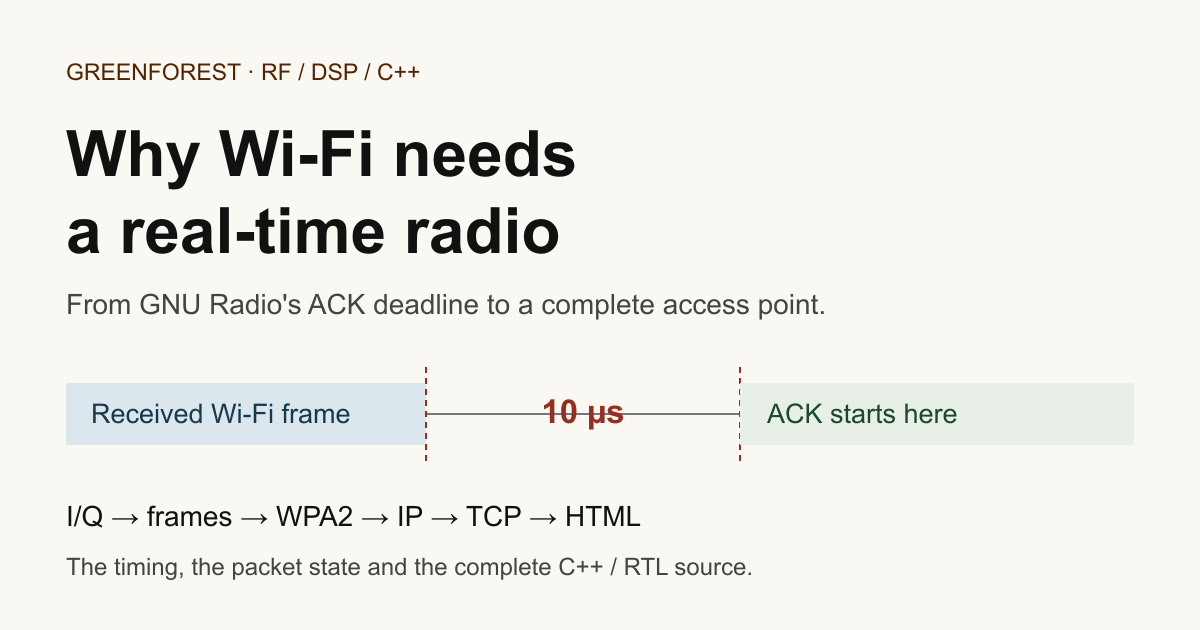
Radio through application
From Barker-spread I/Q to an encrypted HTTP page: the 10 µs reply path, a zero-DSP serial detector, every joining exchange, CCMP byte construction and the C++ network stack. Field maps, worked arithmetic, complete source and build scripts.
Compare purchasable ADCs, scopes, raw PLL binary receivers and microwave mixers. Follow a two-core up/downconverter and four-core Weaver receiver from one RF input to a sampled IF.
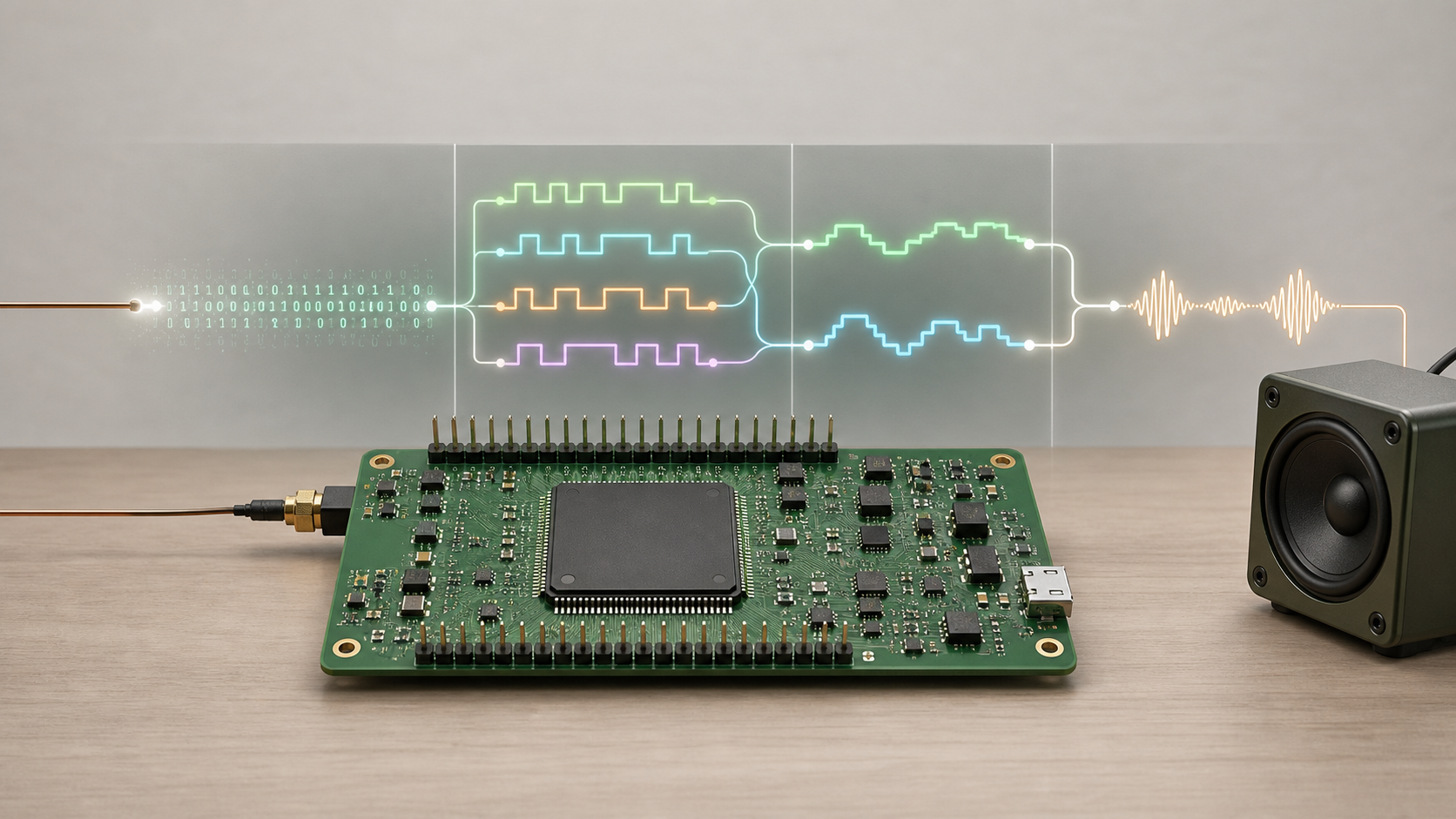
RF receive
A thresholded RF stream enters one logical differential iCE40 input site. DDR decisions become I/Q bit lanes, DDS sign bits control four XOR-and-popcount terms, and a later I/Q cross product recovers FM phase movement before sigma-delta audio.
The September 2026 receiver adds FPGA-only bias regulation, full-band capture and numerical I/Q. Hear the actual no-external-LNA recording and download the complete source. The original article preserves the earlier analog-audio design.
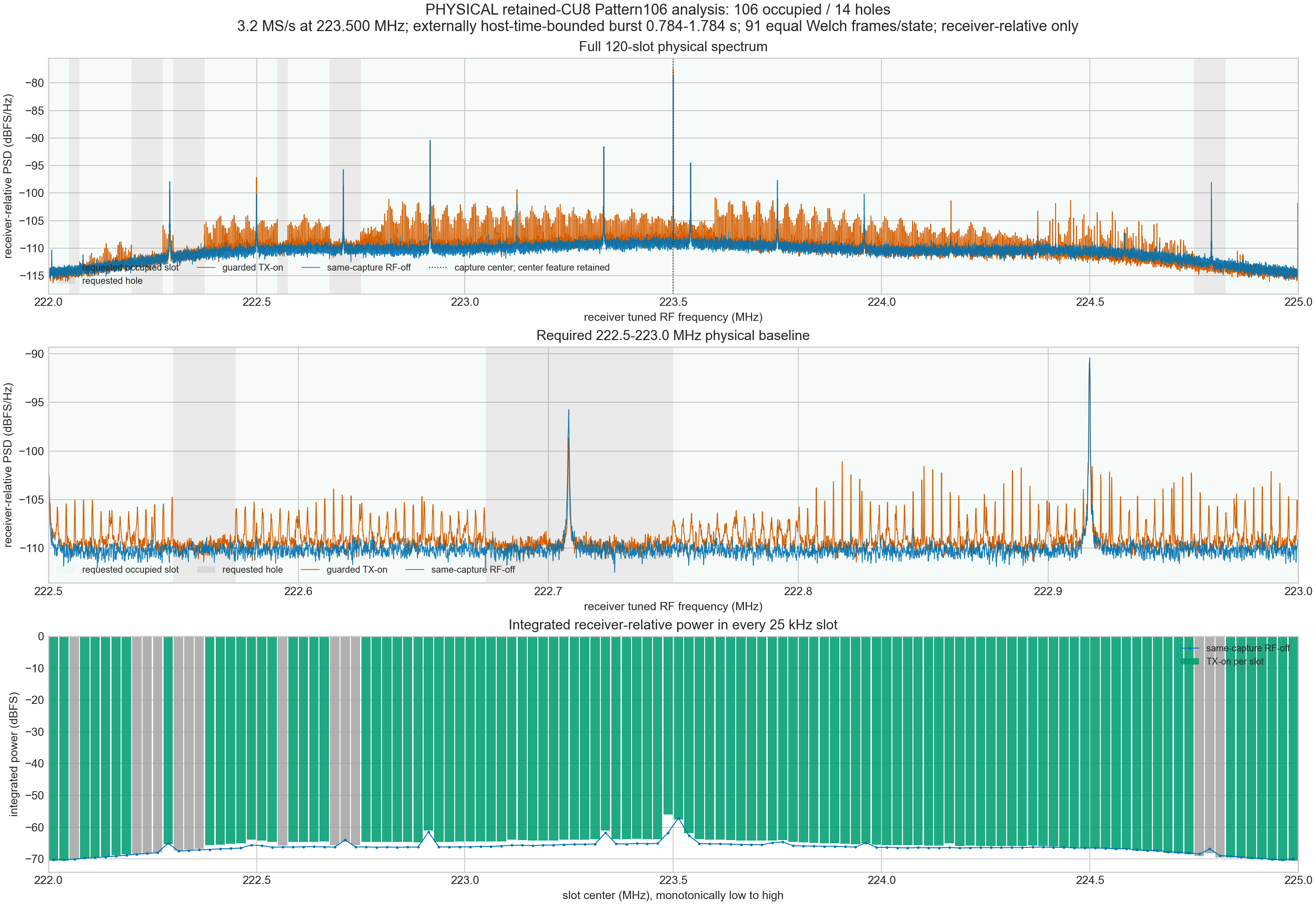
RF transmit · 106 concurrent channels
The HX8K implements 106 independent 24-bit phase engines, deterministic FM motion, twin 128-leaf bit-serial I/Q trees, signed sigma-delta conversion, and a 7.5 MHz complex rotation before four 216 MHz phases converge on N16.
The complete SystemVerilog, support RTL, constraints, build, volatile-SRAM loader, hardware guide, and ready-to-load image are MIT licensed. Own the architecture and build it.
Network and configuration
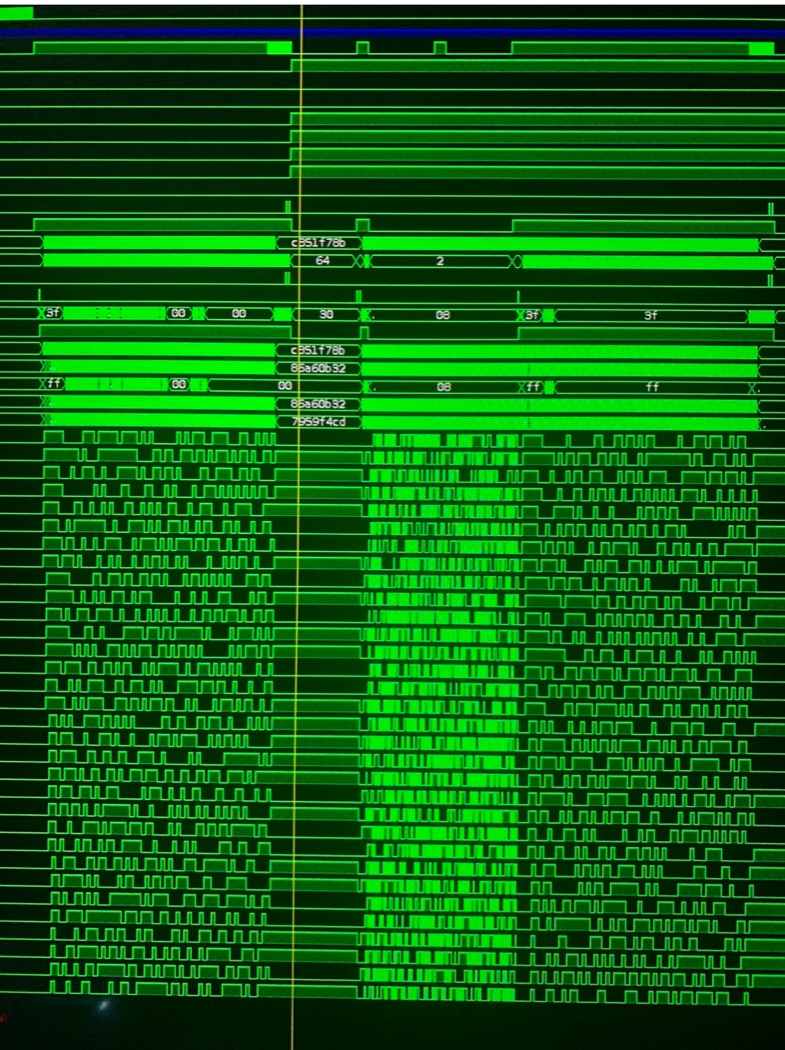
A 2020 multi-file system receives RMII Ethernet, answers ARP, ingests a fixed-layout bitstream through IPv4/UDP, stores it in FPGA RAM, and controls an adjacent iCE40LP384 configuration interface directly.
The Linux sender combines UDP, epoll, XCB, EGL, and GLES2 in one control shell.
Arithmetic scheduling
The SystemVerilog core produces one low 64-bit product every 64 clocks at 216 MHz: 3.375 million products per second from 254 LUT4s and 635 flip-flops.
Twelve independent cores fit the HX8K and deliver 40.5 million products per second. The article publishes the RTL, build, utilization, host verifier, and physical run data.
Binary32 arithmetic
Raw IEEE binary32 words cross the boundary LSB first while significands, exponents, and signs move through one-bit internal streams. A 216 MHz HX8K accepts a new finite-normal division every 32 clocks.
Three serial multipliers, eight add/subtract engines, and three comparators turn the continuous schedule into 6.75 million correctly rounded finite-normal divisions per second, with open RTL and complete rebuild files.
Tangible logic
Input, constant, selector, route, and intersection PCB variants turn circuit role, orientation, and topology into objects that learners can assemble and change by hand.
This physical teaching alphabet carries the logic of MUXes and LUTs out of diagrams and into palm-scale compositions.
Spatial reconfiguration
Cartilage organizes cells into locally coherent regions with owned ports, state, routing, and replacement. Its learning path runs from one MUX through LUTs, drivers, clock distribution, state, timing, metal, composition, and runtime instantiation in adjacent space.
Run Cartilage Core, then follow the editor, simulator, ownership, and recovery roadmap. The architecture invites funding, implementation partners, and contributors.