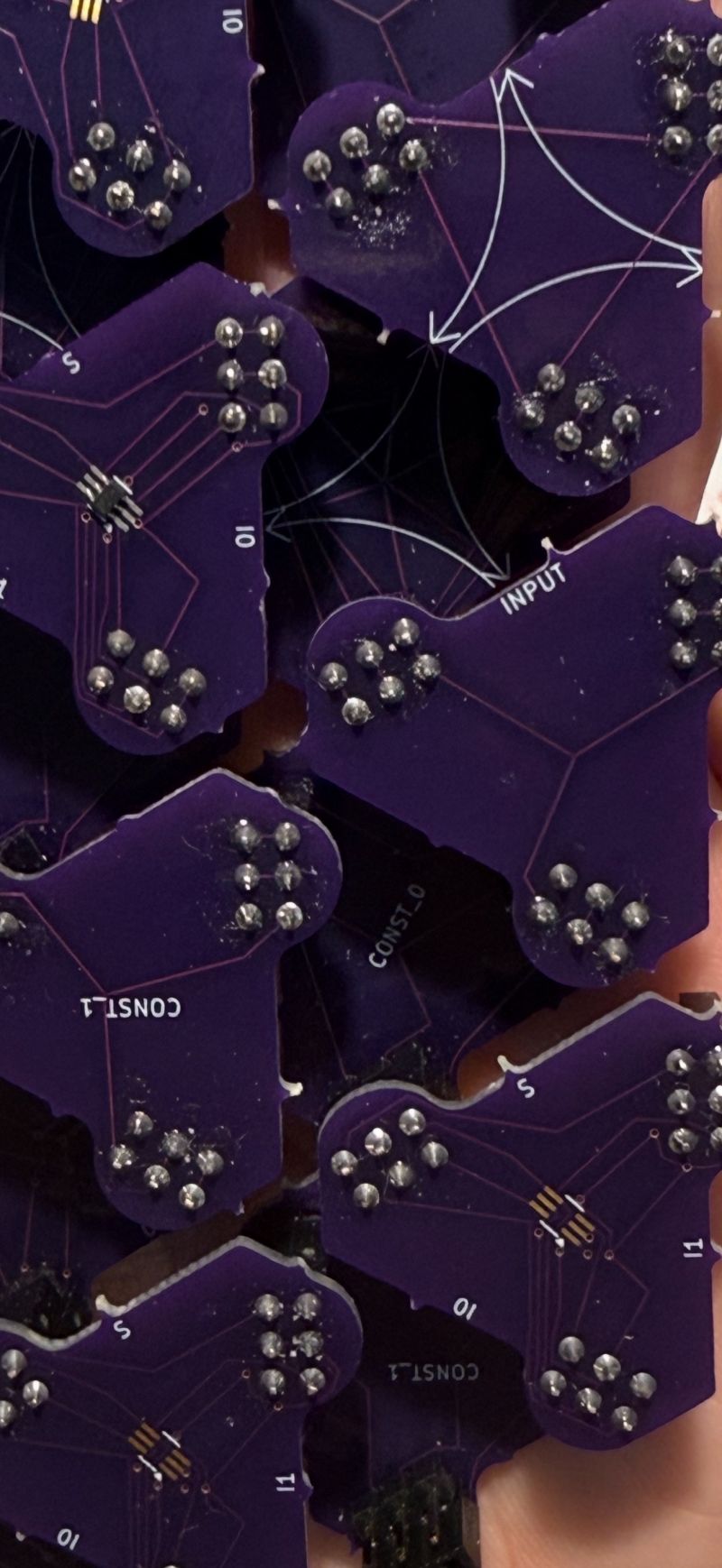
Cartilage gives Brian Greenforest a place where computation behaves like material: visible while it runs, coherent while it changes, and governed by boundaries that remain real.
The instrument preserves structure, ownership, timing, mutation, identity, and continuity instead of flattening those relationships behind an ordinary computer stack.
Enter a World Whose Laws Stay Visible
Objects occupy regions and keep their identity. Ports and routes expose relationships. Runtime change can replace part of the world while the remaining structure continues to make sense.
Mounted on a wall and always available, the instrument becomes a room for thought. A world can appear, pause, transform, and yield to another world without losing its governing architecture.
Give Ideas a Physical Body
Graphics and FPGAs contribute mechanisms, yet the complete identity reaches beyond either category. Cartilage serves as an instrument for coherent mutation and direct work on the variables Brian values most.
Artists, programmers, chip designers, and research partners can enter this world, shape live structures, and help develop a computing medium whose architecture never disappears.
Execute Why This Instrument Exists Through Cartilage Runtime Instantiation
Cartilage Runtime-Instantiation Architecture carries this system into nested modules that enter and connect inside a live spatial machine.
LinkedIn status when archived: Visible to anyone on or off LinkedIn.
Why I Need This Instrument
I am building this because ordinary computers hide the parts I care about most.
They hide structure.
They hide ownership.
They hide the rules of change.
They are powerful, but they make me work through layers that flatten my thinking.
This instrument is different.
It lets me build worlds that stay visible while they run.
It lets me change things while they are alive, without everything collapsing.
It lets boundaries remain real.
It lets objects keep their identity.
It lets the system grow without turning into a mess.
I need that.
Not as a demo.
Not as proof.
Not to impress anyone.
I need a place where computation behaves like a material I can shape, inspect, and govern.
A place where I can work directly on:
• structure
• ownership
• timing
• mutation
• continuity
This is not about “graphics” or “FPGAs” or a project category.
It is an instrument for coherent mutation.
It solves a personal problem:
how to make real things without betraying the architecture in my head.
It gives me a way to think in public without flattening my thinking.
It gives my ideas a body.
And when it is mounted on the wall, always there, it stops being a prototype.
It becomes a room I can enter.
A world can appear.
A world can pause.
A world can be replaced coherently.
The laws remain visible.
That is fun.
That is why I am building it.
Not because it is the fastest machine.
Because it is the first one that lets me work on the variables I love most — directly, honestly, and alive.
Comments added by Brian Greenforest on LinkedIn
This comment was also preserved verbatim from Brian Greenforest’s LinkedIn data export or the public post page.
Comment 1 · (2026-02-25 21:04:05 UTC)
View the LinkedIn post