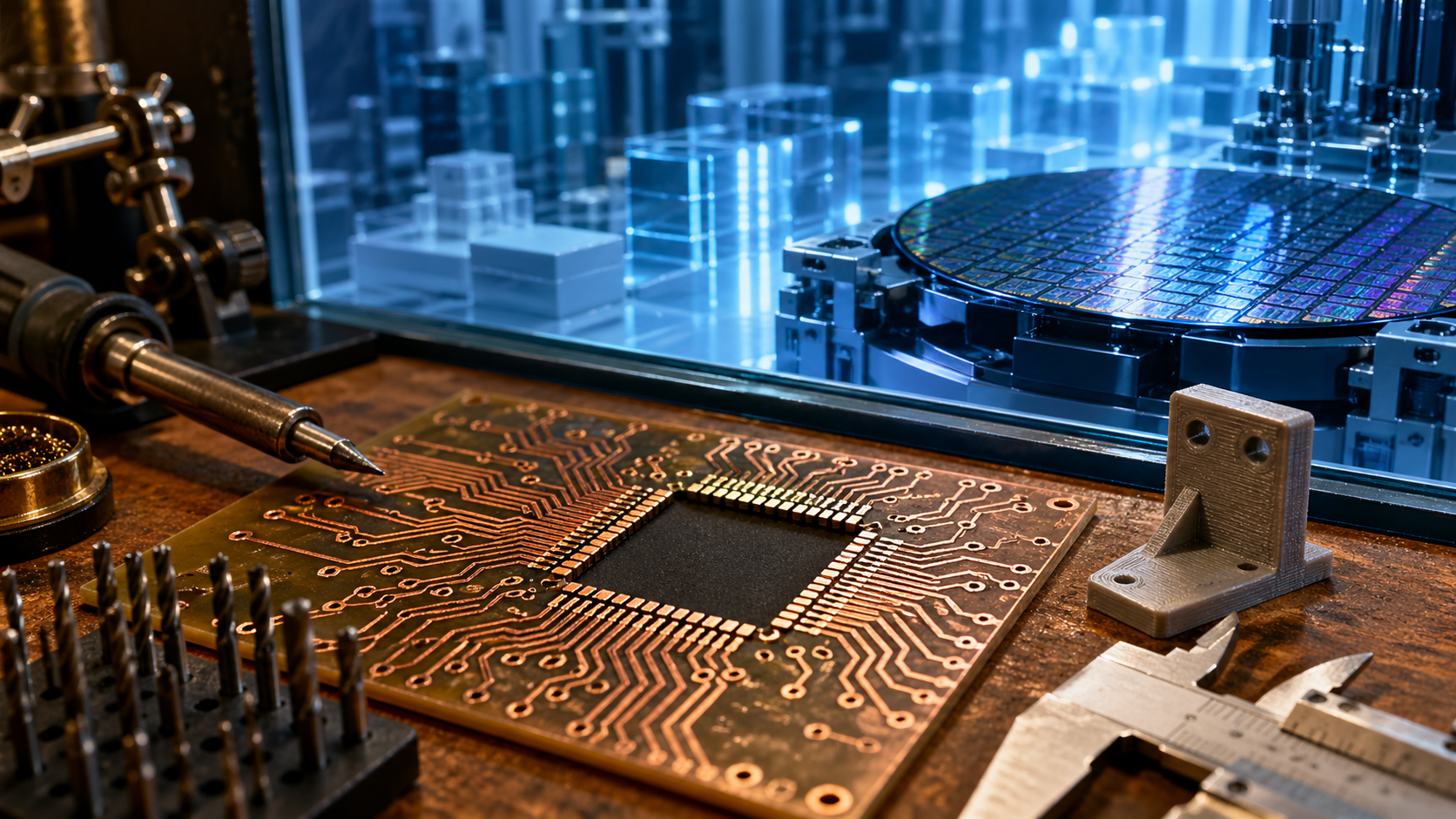
Open Design Already Reaches Silicon
Independent teams can design processor cores, route boards, publish HDL, run open toolchains, and send open-source chip designs through programs such as the Google/SkyWater/Efabless shuttle. Those programs lowered the barrier to silicon design and carried community digital systems into real foundry silicon.
PCB fabrication offers the model for the next step. Regional shops laminate, expose, etch, drill, plate, test, scrap, and repeat. One open-access process combines copper ink, epoxy insulation, CO2 laser drilling, and laser sintering to create multilayer vias without chemical plating. Commercial HDI shops already laser-drill microvias and plate copper at production quality.
A civic active-device process can bring the same local iteration, inspection, and repair culture from interconnect into the nonlinear devices themselves.
The Active Device Must Deliver A Complete Family
Community labs already make conductors, insulators, connectors, mechanics, thermal parts, antennas, housings, batteries, fixtures, test rigs, RF structures, dense boards, and software. The next process must add hundreds of thousands of fast, reliable, cascadable nonlinear gain elements through an open recipe and maintainable equipment.
Silicon succeeds because it combines gain, switching speed, density, and repeatability. A logic gate restores a level, drives the next gate, rejects noise, survives billions of transitions, and fits beside a hundred thousand neighbors. A civic-scale alternative must unite those properties above 10 MHz in one locally repeatable flow.
Magnetics And Vacuum Devices Define Useful Extremes
Magnetic amplifiers show that nonlinear gain can emerge without silicon. Their cores, windings, drive power, and AC or clocked energy systems offer robust switching and amplification. A civic process would need to translate that physical intelligibility into far denser arrays.
Vacuum tubes supply gain, speed, and inspectable structure through sealed envelopes, cathodes, feedthroughs, alignment, heating, contamination control, and disciplined packaging. Their requirements clarify the production challenge: create a hundred thousand matched active elements without giving up local maintainability.
Memristors Bring State Into The Device
A memristor supplies a nonlinear, stateful, time-varying element. Pumped memristive circuits can amplify in principle, and memristive logic can compute. Turning that primitive into a complete local family requires write/read discipline, inversion, restoration, fanout, isolation, clock or pump distribution, endurance, drift control, and large-array yield. Many proposals pair the devices with CMOS sensing, inversion, restoration, or peripheral control; a civic process must absorb those functions into its reproducible flow. The read/write drift problem provides one concrete target for device and circuit co-design.
Vertical OECTs Point Toward The Target
Fast vertical organic electrochemical transistors combine a three-terminal device, low-voltage operation, multi-valued logic, and reported access frequencies above 10 MHz. The 2023 Advanced Materials paper on monolithic tandem vertical electrochemical transistors reports ternary gates, full voltage swing within 1 V, and access to multiple logic states above 10 MHz.
That combination makes OECTs a compelling candidate for post-CMOS local electronics.
The vertical geometry uses controlled organic layers, ion gels, patterned electrodes, and disciplined processing. Fully 3D-printed OECTs add a complementary fabrication route. The research program can join their strengths and drive toward a hundred-thousand-element open fabric with yield, fanout, standard cells, clocking, aging data, repair rules, test coverage, and a trusted packaging flow.
Local Fabrication Makes Trust Measurable
A hardware root of trust extends below software into the physical process. OpenTitan opens the root-of-trust architecture and implementation; a civic fab can extend that transparency through manufacture.
Hardware Trojan research shows how design or fabrication changes can hide triggers from ordinary testing. Locality changes the verification surface: communities can inspect masks, audit materials, measure process drift, compare wafers or panels, destructively sample lots, and reproduce a device in another shop.
Repeated physical verification can replace vendor belief with a chain of locally inspectable measurements.
Process Access Sets The Iteration Speed
Software can change in minutes, a local PCB in hours, a commercial board in days, and a printed fixture before lunch. Active-device iteration now depends on institutional equipment, scarce recipes, hazardous chemistry, cleanroom schedules, remote shuttles, and vendor catalogs.
A regional process shortens that loop. Equipment availability, materials, test cells, repair rules, and local expertise become design variables that teams can improve directly instead of fixed external queues.
The Invention Is A Complete Civic Process
The process uses available materials and ordinary lab air or affordable containment. It prints, plates, mills, sinters, laminates, cuts, or etches with equipment that a regional shop can buy and repair.
Nonlinear gain elements and passive interconnect share one flow. Digital logic and multi-stage analog amplification exceed 10 MHz. Fanout and restoration carry signals across at least hundreds of thousands of elements. Open physics, test cells, and process records let communities model, reproduce, compare, and improve every generation.
The Next Frontier Brings The Substrate Home
The maker movement can build the board, harness, enclosure, firmware, fixtures, and tools around intelligence. Civic-scale fabrication adds the dense active fabric that executes it.
Open hardware reaches a new scale when makers fabricate their own fast active devices.
Design them, fabricate them, measure them, scrap them, improve them, and teach another town to reproduce the process.
Build The Comparison Program
Choose candidate device paths, fabricate test cells, and measure gain, restoration, fanout, interconnect, speed, drift, endurance, yield, equipment cost, material stability, and reproducibility across labs. The first failing requirement directs the next device or process change.
OECTs, memristive circuits, magnetic amplifiers, printed conductors, laser-sintered interconnect, wafer-diced protected chiplets, and hybrid flows can share the same target: a locally reproducible control and compute substrate with enough gain, fanout, restoration, routing, and test coverage for useful machines.
The program invites materials collaborators, measurement equipment, process expertise, lab and fabrication access, funding, and partners ready to build regional active-device capability as infrastructure.