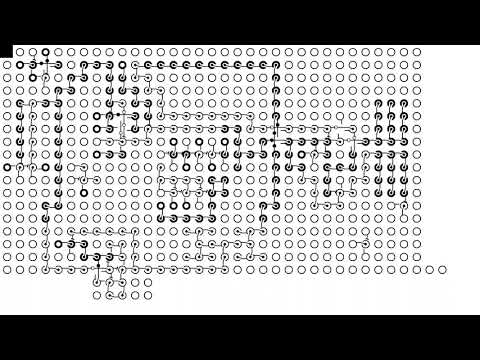
Render the Architecture as a Living Surface
Each pixel can represent local state or a cell function, while the shader evaluates many cells in parallel. That correspondence makes WebGL a natural medium for exploring arrays whose physical implementation also relies on massive local parallelism.
The early design used a single reconfigurable MUX as its finest switching element. Later work increased node capability so each cell could compute and manage adjacent configuration without wasting control circuitry.
Use Visualization to Accelerate Hardware Design
A visible fabric helps engineers compare granularity, routing, state, and communication before committing to a board or chip. It also gives students an immediate way to connect shaders with reconfigurable logic.
Explore the rendered fabric, inspect the newer Cartilage implementations, or collaborate on the next visualization and hardware mapping.
Execute A Shader for Nano-FPGA Fabric Through Cartilage Runtime Instantiation
Cartilage Runtime-Instantiation Architecture carries this system into nested modules that enter and connect inside a live spatial machine.
Cartilage Runtime-Instantiation Architecture · Cartilage Core · public source repository · https://youtube.com/watch?v=irna23iEQBA&feature=share