Open The Complete Timeline Package
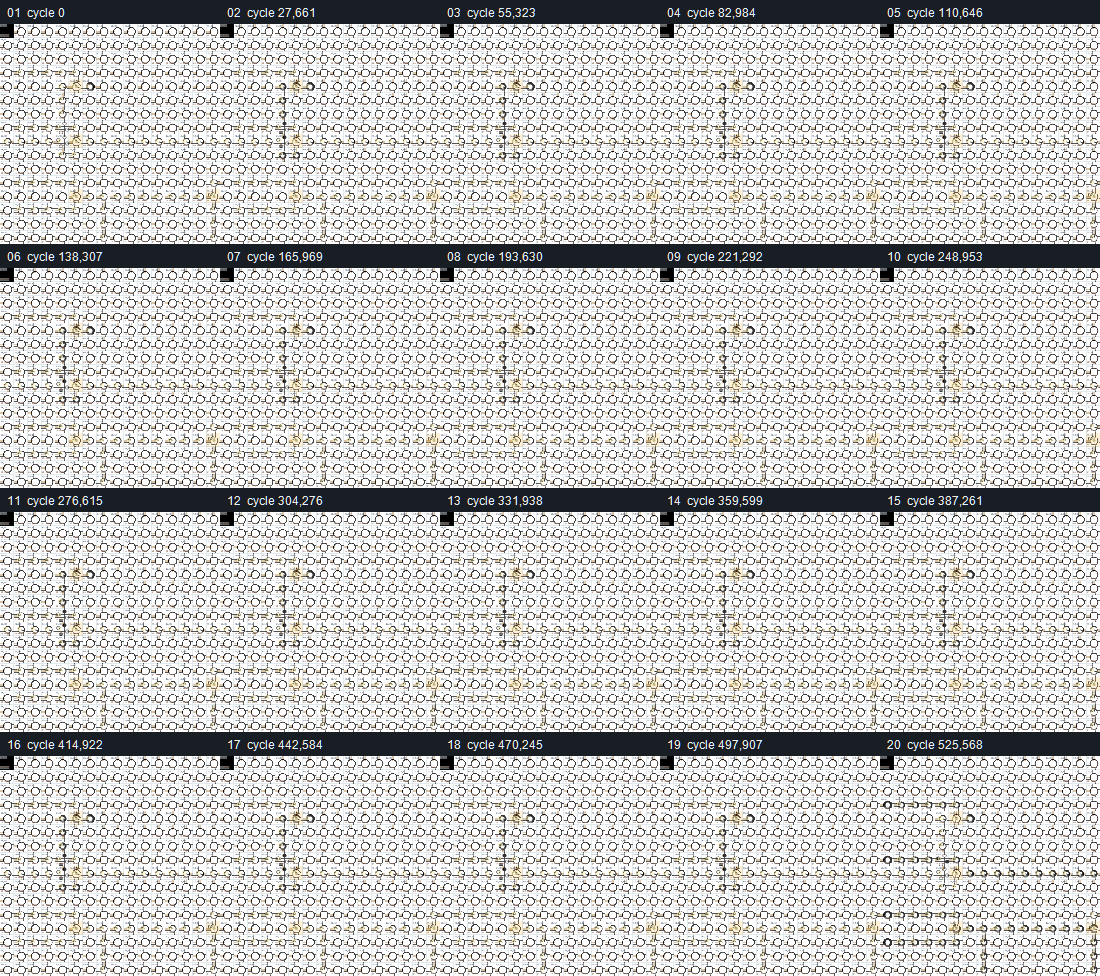
The media and source record live together under cartilage/codex5.5/. The ten-second video presents the sequence at two states per second, while the contact sheet places every exact cycle label on one page.
- quadflow-cartilage-525568-timeline.mp4 presents 20 states in a ten-second H.264 video at two states per second.
- quadflow-cartilage-525568-timeline.gif loops the same frame sequence in a web-native preview.
- quadflow-cartilage-525568-timeline-contact.png collects all 20 labeled states on one sheet.
- quadflow-cartilage-525568-timeline.md records the run context and the committed-state sampling method.
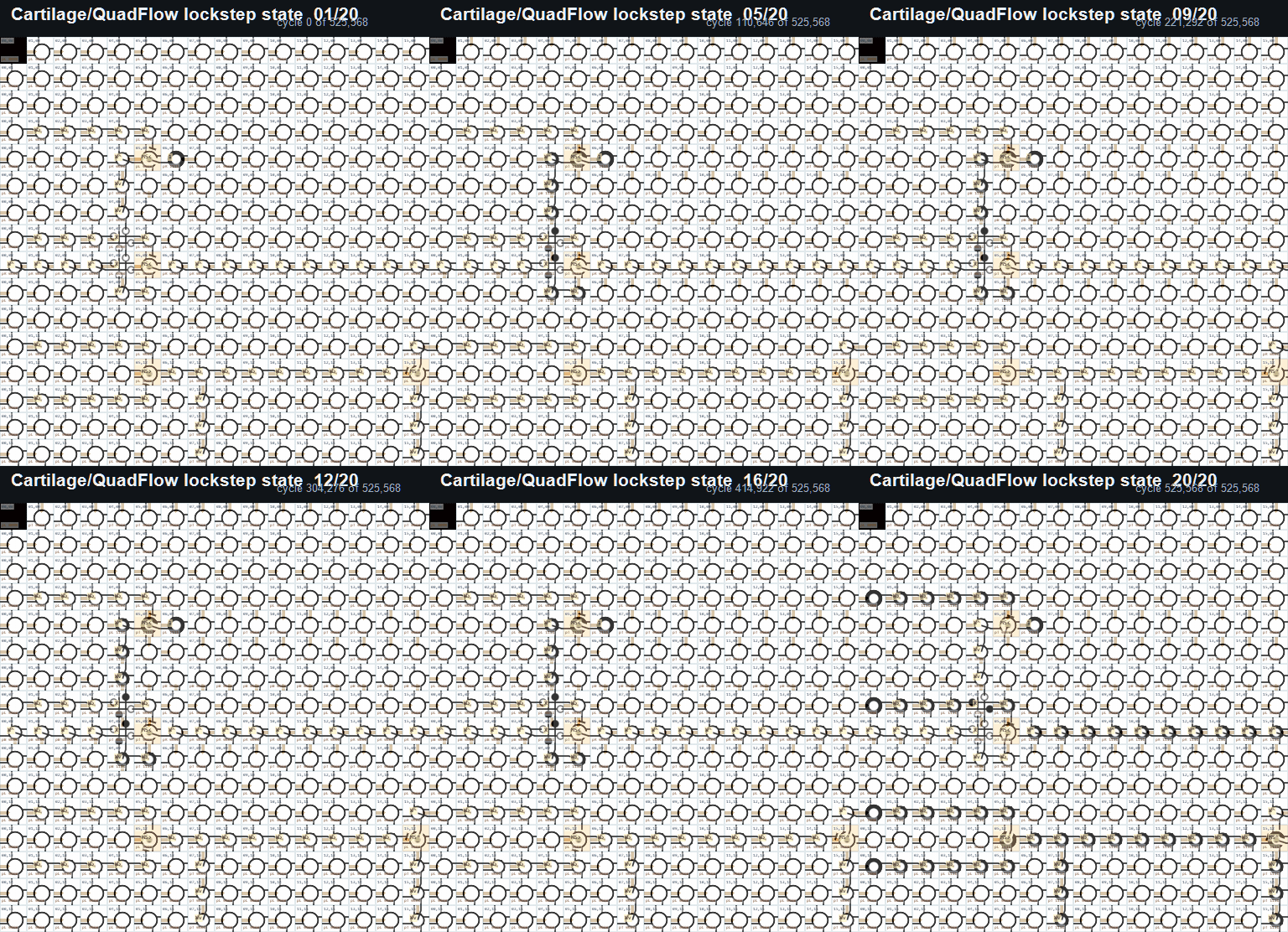
Watch The Run Advance At Two States Per Second
Compare Every Labeled Cycle On One Sheet
Drive A Reversible Ripple Adder Through 525,568 Cycles
External lockstep edge I/O drives the 64x64 Cartilage GLSL fabric through a long regional reconfiguration sequence and into its expected final state.
The driver streams 7,956 parsed QFG frame declarations and completes 704 browser expectations. The last visible state records the committed result after the 2-bit to 3-bit to 2-bit reversible ripple-adder sequence.
Connect Committed Frames To In-Flight Configuration
The renderer exposes committed cell and body state, while configuration shift registers carry additional in-flight bits between captures. The lockstep driver continues advancing the fabric, shifting configuration, and checking edge behavior even when two sampled images look nearly identical.
The timeline therefore presents exact checkpoints from the completed run; the cycle labels connect each visible state to the denser internal traffic that advances between frames.
Make Nested Reconfiguration Visible Over Time
The Cartilage nested-instantiation article develops local ports, bounded daughter regions, serial configuration streams, tile roles, and composability inside the fabric.
This timeline carries those ideas through a long browser execution, joining regional reconfiguration to exact cycle labels and checked edge behavior.
Use The Timeline As A Temporal Index
The 20 committed states provide stable entry points into the driver, QFG frame stream, edge checks, and internal configuration path. A richer trace viewer can attach those signals to the same cycle index and preserve the existing timeline as its visual overview.
Decode Each Committed Fabric State
Thirty-two Cartilage body-role codes cover the reconfiguration port, cross, constants, four wire orientations, and six MUX modes in four orientations. The Cartilage Visual Language provides the complete key for reading every frame.
Carry The Timeline Into The Current Core
Cartilage Core and the public source repository provide the current compact browser and hardware mechanism. The cartilage/codex5.5/ package supplies this exact 525,568-cycle QuadFlow run.
Keep Every Frame Attached To Its Run Coordinates
Each label binds one committed state to its cycle count, the 7,956 parsed QFG declarations, and the 704 completed browser expectations.