NVIDIA GPUs Are Not Universal Computers
August 11, 2023
NVIDIA GPUs deliver extraordinary throughput when thousands of lanes can perform similar work over regular data. They do not replace every computer, because control flow, memory access, writes, latency, locality, and communication shape the actual workload.
Brian Greenforest frames architecture selection as a mapping problem: give each computation the machine whose physical organization matches it.
Know Where the GPU Wins
Scientific simulation, dense linear algebra, graphics, and deep learning expose abundant data parallelism. Wide SIMD-style execution and high-bandwidth memory turn that regularity into immense throughput.
Complex branching leaves lanes idle. Irregular gathers and scattered writes defeat coalescing, while a single thread that emits massive state can hit memory and synchronization limits long before arithmetic peaks.
Use the Complete Computing Palette
CPUs handle latency-sensitive control and irregular work. FPGAs construct custom pipelines and interfaces. ASICs optimize stable high-volume kernels, and spatial fabrics preserve locality across changing parallel systems.
Engineering teams can profile branching, data movement, write patterns, latency, and utilization before choosing hardware. The strongest system combines architectures around the workload instead of forcing every problem through a GPU.
LinkedIn status when archived: Visible to anyone on or off LinkedIn.
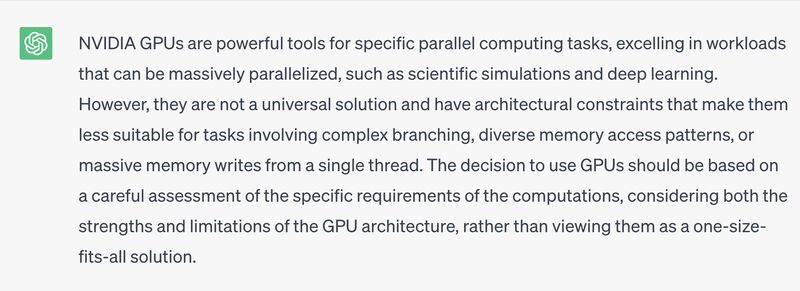
NVIDIA GPUs are powerful tools for specific parallel computing tasks, excelling in workloads that can be massively parallelized, such as scientific simulations and deep learning. However, they are not a universal solution and have architectural constraints that make them less suitable for tasks involving complex branching, diverse memory access patterns, or massive memory writes from a single thread. The decision to use GPUs should be based on a careful assessment of the specific requirements of the computations, considering both the strengths and limitations of the GPU architecture, rather than viewing them as a one-size-fits-all solution.