See The Generated Two-Bit Datapath
Add All 16 Input Pairs
The adder consumes all 16 combinations of two two-bit words and exposes the three-bit result:
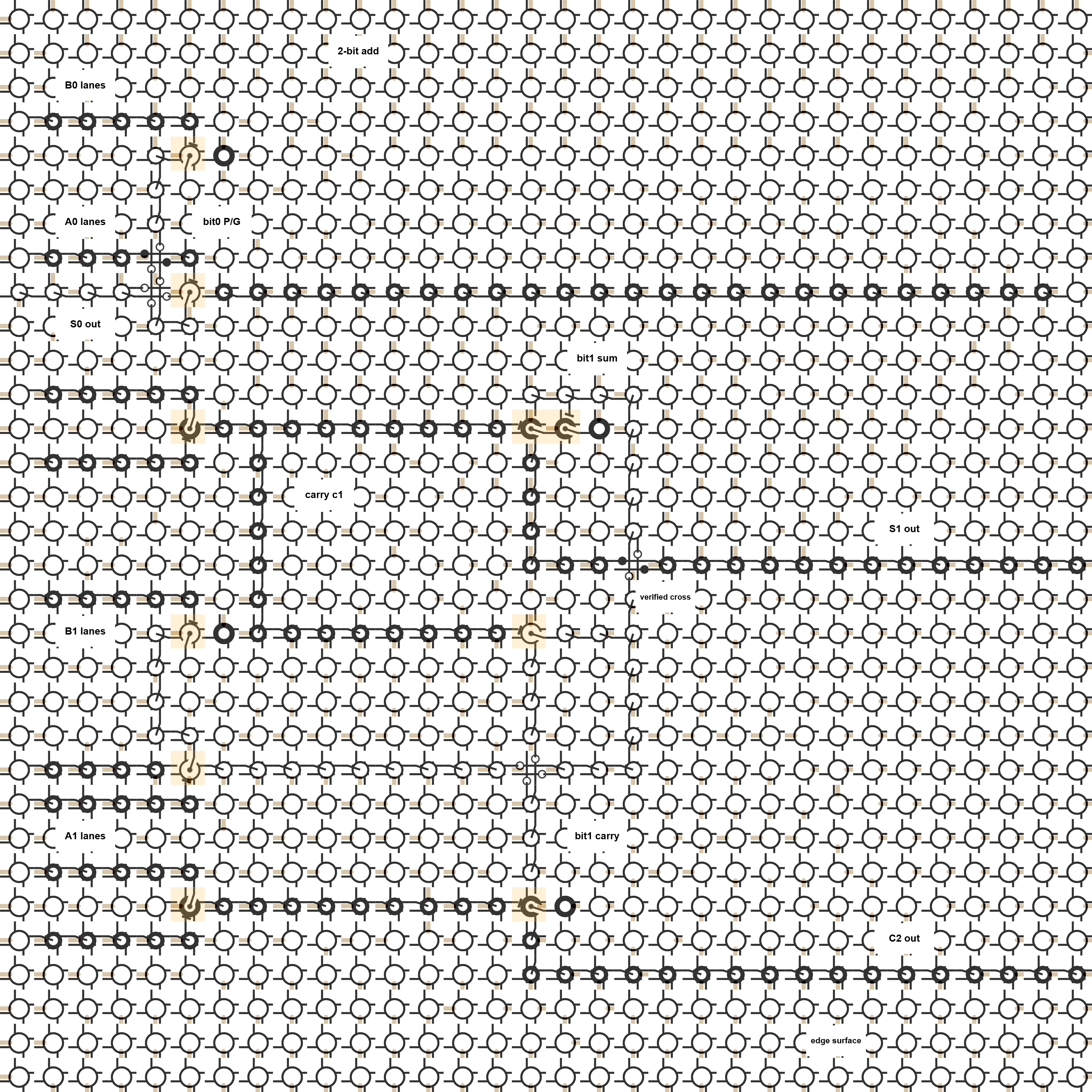
{C2, S1, S0} = A[1:0] + B[1:0]The generated QFG places every primitive Cartilage cell directly. Its visible crossbars route intentional signal crossings inside the circuit.
Advance 3,072 Lockstep Fabric Updates
The browser/GLSL engine streams each QFG frame through the fabric and checks the arithmetic result at every frame transition:
207 explicit seed cells
16 parsed QFG frame declarations
3072 lockstep fabric updates
96 browser expectations checked
96 browser expectations passed
The QFG source defines the placed circuit, the report records all 96 passing expectations, and the image makes the generated routes readable at full resolution.
Read Three Result Bits At The Fabric Edge
Ordinary edge-visible lanes carry all three result bits:
S0 exits on the left edge at row 8
S1 exits on the right edge at row 16
C2 exits on the right edge at row 28
The final frame adds a=3, b=3 and produces binary 110. Active right-edge lanes 16 and 28 carry S1=1 and C2=1; the inactive left-edge lane at row 8 carries S0=0.
Open The Circuit And Its Complete Run Record
browser-static-ripple2-adder-edge.qfg contains the generated source netlist, and verification-report.md records the full run.
The screenshot turns those placed cells into a readable spatial circuit, while the source and report carry the exact frame declarations, expectations, and results.
Advance From Placement Maps To Generated Arithmetic
The full-adder islands and PC-stepper islands pages contribute spatial design maps. The three MUX lanes page contributes an edge-driven selector run. This ripple2 adder combines both strengths in one generated arithmetic circuit.
Generated source, a readable route map, edge-visible result lanes, and 96 passing expectations create a complete public path from circuit definition to browser execution.
Connect Four Views Of One Run
The QFG source defines the cells, the report records the frame-by-frame checks, the render exposes the routes, and the edge lanes display the arithmetic result from the same generated run.
Cartilage Core and the public source repository supply the current compact browser and hardware mechanism. This page’s QFG and run report supply the exact two-bit adder package.