Rocks, Photons, and Spacetime Motion
July 20, 2022
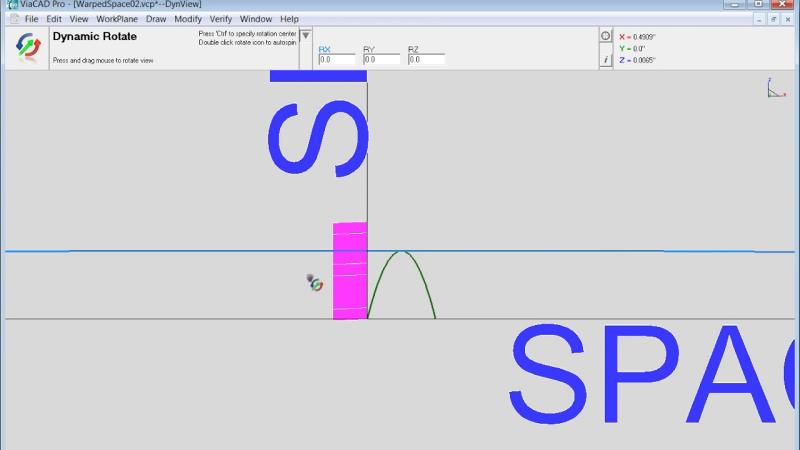
A rock that rises and falls and a photon crossing space look radically different in three dimensions. In spacetime, both become trajectories governed by geometry, and the comparison makes inertial motion newly vivid.
Brian Greenforest uses the picture to connect Newton’s first law, falling bodies, relativistic four-velocity, interactions, and the way curved spacetime changes what a straight path means.
Motion Uses Space and Time Together
A massive body at rest in space still advances through time. Relativity combines those components into four-velocity, whose invariant magnitude carries the constant c for timelike motion.
A photon follows a null path, so its spacetime interval differs from the rock’s timelike path. Both nevertheless reveal why c organizes the geometry rather than acting only as the speed limit for light.
Gravity Changes the Geometry of the Path
A freely falling rock follows the straightest available path through curved spacetime. On an Earth-centered spatial picture, that geodesic appears as a rise and return.
Use the linked visualization to connect the equations with the trajectory. Physics educators and curious builders can turn the same picture into an interactive model of inertial motion and gravity.
Watch the Spacetime-Motion Argument
The linked presentation gives the rocks, photons, and motion argument a direct visual and physical reference.
LinkedIn status when archived: Visible to anyone on or off LinkedIn.
This video explains that "Every body continues in its state of rest, or of uniform motion in a straight line, unless it is compelled to change that state by forces impressed upon it." applies to a thrown rock that falls back on Earth too, not only for straight line inertial movements, AAAAAAAAND... that the rock travels just as fast (c) through spacetime as an individual photon, at all times when there are no interactions with other rocks (and molecules in the air.)