The Supergoal Organizes the Toolchain
Dynamic programming and operations research search large decision spaces. Mathematical optimization selects useful configurations. Chaos theory and nonlinear systems describe sensitive dynamics. Neural networks approximate relationships that resist closed-form treatment.
General relativity, quantum field theory, and quantum gravity frame spacetime and physical propagation. Theory of computation asks what information processing permits. CMOS, VLSI, FPGAs, Verilog, GPUs, and quantum photonics turn reduced questions into executable models and instruments.
The supergoal gives every layer a reason to meet: transform a deep physical question into mathematics, simulation, architecture, and a physical test that can teach the next iteration.
Graph Models Add Another Way to Ask
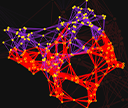
Stephen Wolfram’s work on graph rewriting and spacetime supplied a neighboring research direction. It treats causal structure as something a computational model can generate and inspect, giving communication questions another formal surface.
Progress comes from connecting such models to explicit variables, transformations, device concepts, and observable consequences. The program welcomes physicists, mathematicians, hardware designers, and computational researchers who want to turn a large question into a sequence of buildable ones.